
The challenge
Restaurant operators and franchise groups often manage data across disconnected systems. POS platforms capture sales and tender details; HR systems track labor and scheduling; finance systems hold general ledger and budgeting data; franchising systems manage agreements and royalties; and inventory systems record stock, usage, and waste. Each system may use different definitions, formats, and reporting cycles.
This fragmentation makes it difficult to produce consistent operational reporting and cross-department analysis. Manual reconciliation between systems consumes time and can obscure timely executive insights. Organizations need a more integrated and accessible way to manage multi-system extraction and ingestion, data cleaning, standardization, and quality reconciliation.
Platform architecture
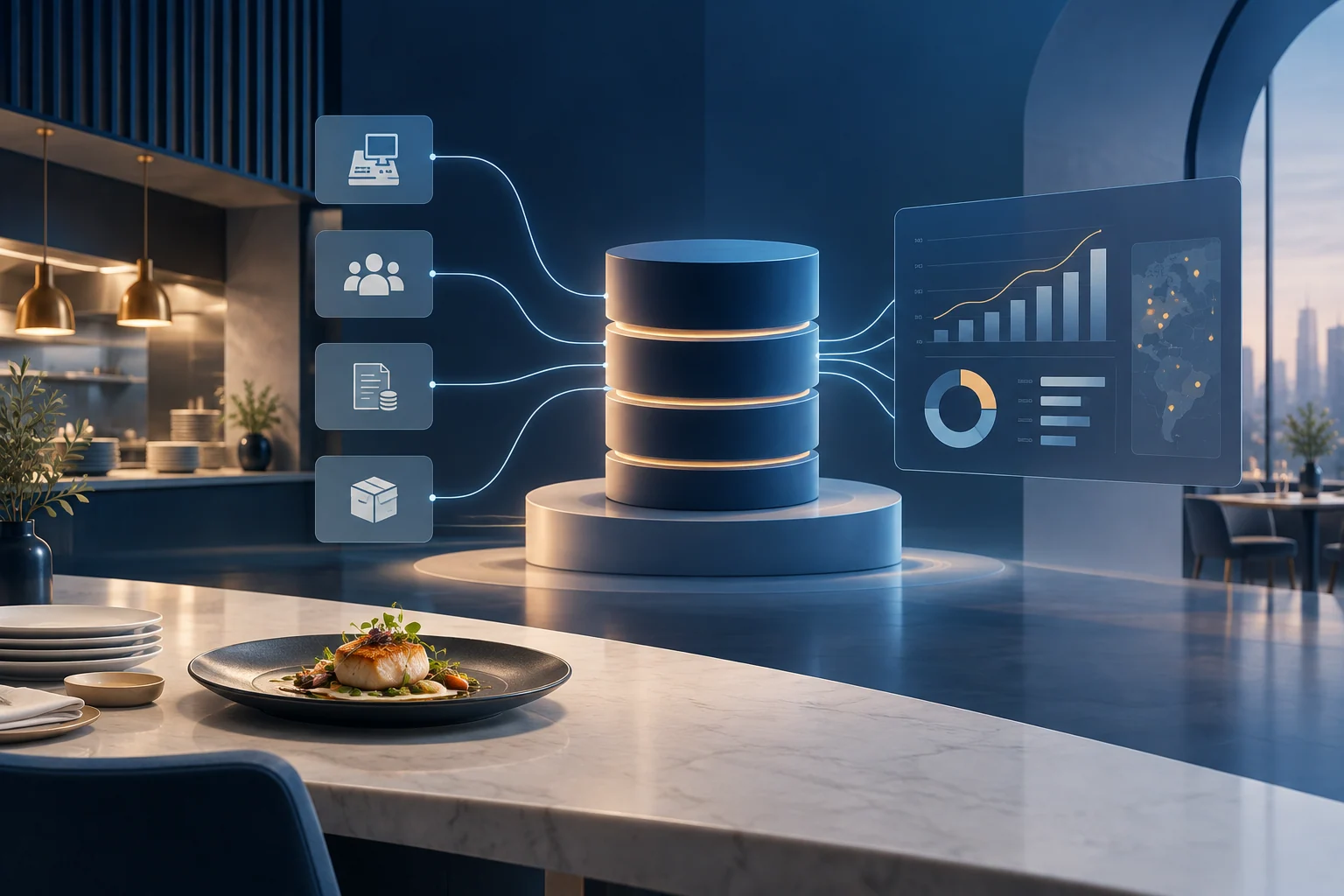
The solution approach covers multi-system extraction and ingestion from POS, HR, financial, franchise, and inventory sources. Data is cleaned, standardized, and reconciled for quality before being loaded into conformed warehouse models and analytics-ready datasets. These datasets support restaurant performance reporting, cross-functional analysis of labor, sales, inventory, and financial activity, and executive dashboards.
A governed enterprise data warehouse provides a shared information foundation for restaurant decisions and reduces the fragmentation of department-level reporting.
Core capabilities
- Multi-system extraction and ingestion of POS, HR, financial, franchise, and inventory data
- Data cleaning, standardization, and quality reconciliation
- Conformed warehouse models and analytics-ready datasets
- Restaurant performance and operational reporting
- Cross-functional analysis of labor, sales, inventory, and financial activity
- Executive dashboards and repeatable management reporting
How it works
- Extract: Data is extracted from POS, HR, finance, franchising, and inventory systems.
- Ingest: Extracted data is loaded into a staging area for processing.
- Cleanse and standardize: Records are deduplicated, normalized, and validated against quality rules.
- Reconcile: Discrepancies across systems are identified and resolved to support consistent reporting.
- Model: Data is organized into conformed dimensions and fact tables within the enterprise data warehouse.
- Publish: Analytics-ready datasets are made available for reporting and analysis.
- Report and analyze: Users access operational reports, cross-functional analyses, and executive dashboards.
Data Domains and Typical Content
| Data Source | Typical Content | Purpose in Warehouse |
|---|---|---|
| POS | Transaction-level sales, menu items, tender types, store identifiers | Sales performance, product mix, and location comparisons |
| HR | Employee records, labor hours, scheduling, pay rates | Labor cost analysis, productivity, and workforce planning |
| Finance | General ledger, accounts payable/receivable, budgets, cost centers | Financial reporting, margin analysis, and budget variance |
| Franchising | Franchise agreements, royalty calculations, territory data | Franchise performance, royalty tracking, and territory analysis |
| Inventory | Stock levels, usage, waste, purchase orders, supplier data | Inventory variance, cost of goods, and waste management |
Business value
A shared data foundation connects restaurant operations and commercial reporting, giving multi-location teams clearer visibility across outlets, inventory, workforce and financial activity.