
The challenge
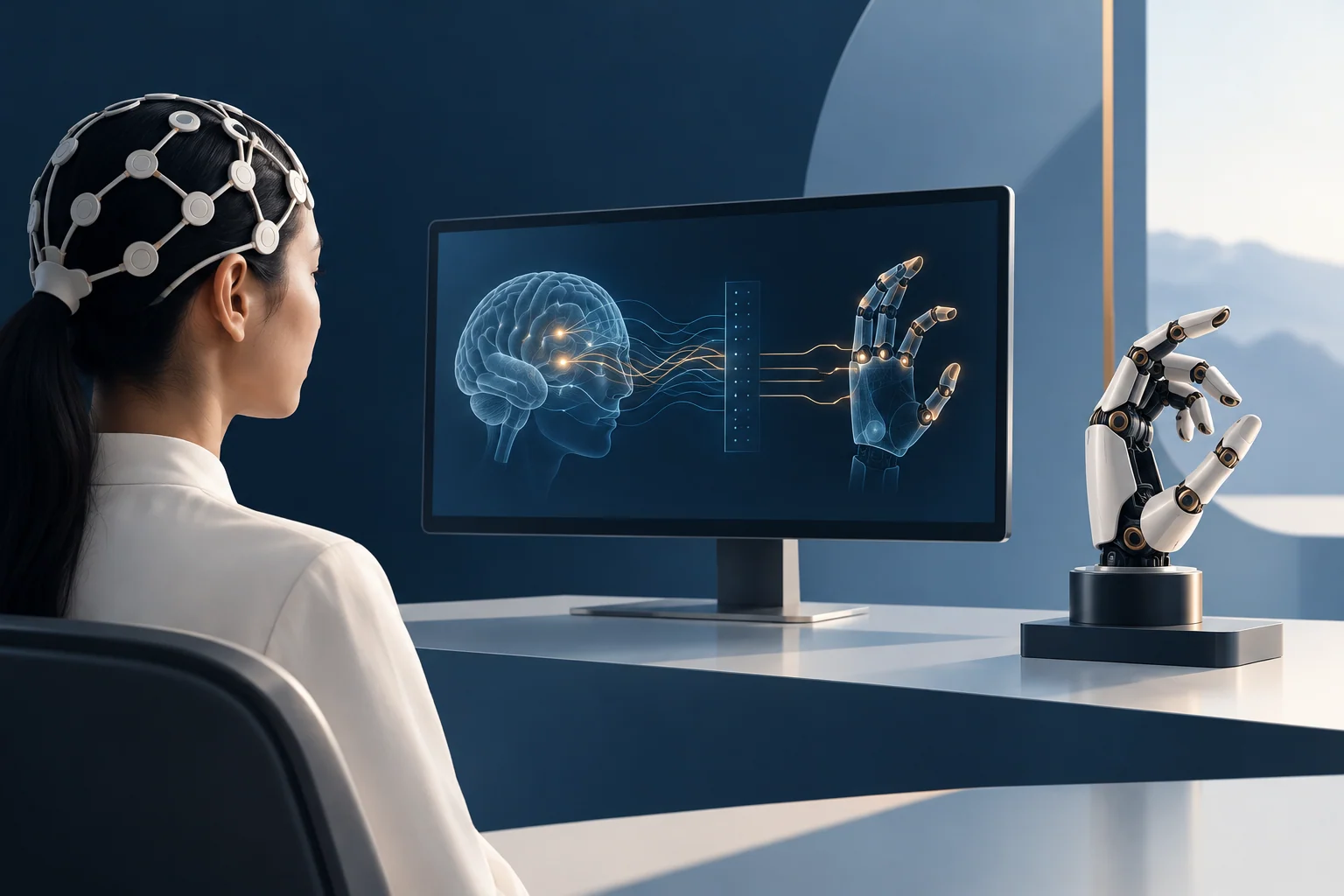
Neural interaction systems require coordinated signal acquisition, preprocessing, model interpretation and dependable output mapping. This application unifies those stages and makes classification and device-command behavior inspectable for engineering teams. It provides interactive control software without presenting the interface as a clinical device.
Operational context
Neural-signal projects often involve multiple disciplines: hardware acquisition, data preparation, model interpretation, and downstream control. A production software interface can help teams examine how those pieces fit together before committing to a larger research program. In this project, the emphasis is on software integration and command generation, not on building the robotic hand itself.
Core capabilities
- Neural signal acquisition: Connects to third-party OpenBCI interfaces to capture neural signals for software processing.
- Signal preprocessing: Prepares captured signals so that learned-pattern interpretation can operate on a more consistent input.
- Learned-pattern interpretation: Applies model-based interpretation to recognize signal patterns and classify states.
- Command generation: Maps classified neural states to supported controls for a connected robotic-hand interface.
- Research review and visualization: Provides a way to inspect model output and understand how interpreted states become commands.
These capabilities describe the software layer. They do not imply clinical-grade performance, autonomous operation, or a validated medical device.
How it works
- Capture: Neural signals are acquired through third-party OpenBCI equipment.
- Preprocess: The software prepares the captured signals for interpretation.
- Interpret: Learned-pattern interpretation recognizes signal patterns and classifies states.
- Map: Classified states are translated into external control commands.
- Control output: Mapped commands are issued to a compatible connected-device interface.
- Review: Model output and command generation can be reviewed and visualized for research purposes.
Signal interpretation and command outputs remain available for engineering review. The system is an interactive software application, not a medical diagnostic product.
Integration architecture
The application connects third-party OpenBCI acquisition equipment with a neural-signal processing pipeline and a compatible external command interface. Engineering users can inspect signals, model outputs and mapped control commands in one workflow.
Business value
The software connects neural-signal acquisition, preprocessing, model interpretation and mapped device controls in a research-oriented interaction workflow. It supports engineering assessment and interactive control, not medical diagnosis.