
The solution
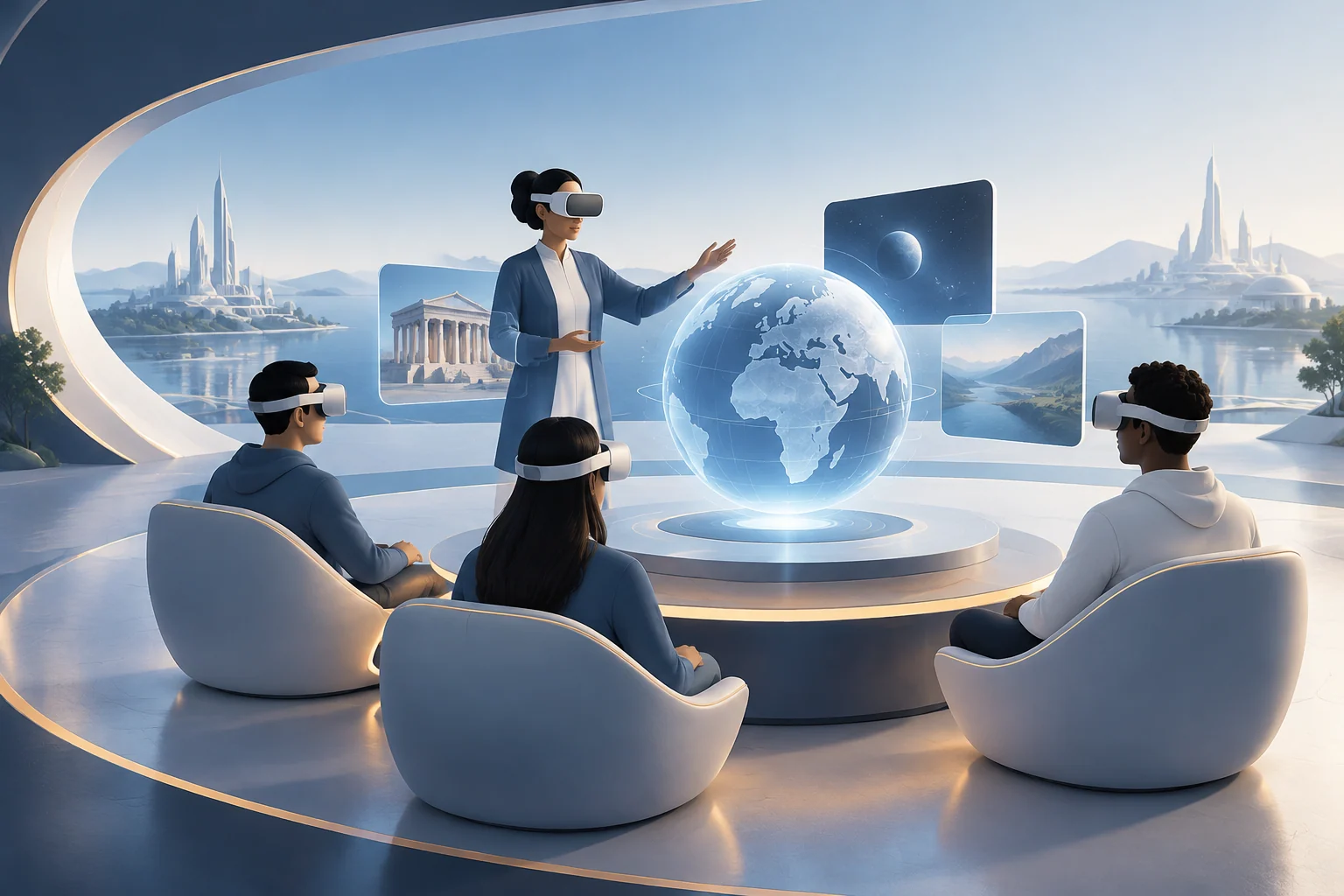
Metaverse School is a collaborative 3D learning environment where instructors and learners join as avatars, communicate in real time and participate in spatial classroom activities. Its software brings together presence, navigation, shared spaces and interactive lesson experiences.
The challenge
Immersive digital learning connects shared 3D spaces, personal avatars and classroom interaction within a navigable virtual environment. Conventional digital learning tools are effective for content distribution, assignments, and discussion, but they often provide limited spatial context and embodied interaction. Immersive environments offer a different setting for instruction and collaboration, where location, movement, and shared presence can become part of the learning experience.
The business question is not whether immersive technology replaces existing platforms. The more practical question is how avatar-based 3D spaces can complement traditional digital learning experiences and where they add value for learners, instructors, and program teams.
Core capabilities
The platform provides multi-user 3D classrooms, personal avatars, real-time communication and interactive educational activities. Modular learning components connect lesson delivery and participant interaction within an immersive environment.
Core capabilities
- Multi-user 3D learning spaces: shared environments where multiple participants can be present at the same time.
- Personal avatars and shared virtual presence: a representation of each participant and a sense of co-presence in the learning space.
- Real-time communication and classroom interactions: support for discussion, instruction, and participant interaction during a session.
- Interactive lesson spaces: navigable 3D environments support classroom activities, guided exploration and participant interaction.
- Extensible learning interfaces: modular activities and instructional tools support different learning formats within the shared environment.
How it works
- Join the environment: a learner or instructor enters the shared digital learning environment.
- Use an avatar: the participant is represented by a personal avatar, establishing shared virtual presence with others.
- Navigate the space: participants move through an explorable 3D learning space to reach a lesson area, activity, or discussion point.
- Communicate in real time: instructors and learners interact through classroom communication features.
- Participate in interactive lessons: instructors coordinate learning activities using shared 3D spaces and real-time collaboration.
- Collaborate: learners take part in shared activities that use spatial context and avatar-based presence.
- Extend the experience: educators configure virtual activities and learning interactions for different topics and cohorts.
Business value
Shared virtual classrooms give educators a spatial environment for lessons, student participation and collaborative activities, extending digital learning beyond static pages and video calls.