
The challenge
Enterprise and professional services organizations often operate front desks, welcome areas, and customer-service points that must handle a mix of routine inquiries, visitor registration, and directional questions. Staff members are frequently interrupted by repetitive requests, while visitors expect immediate, accurate, and multilingual responses. Digital self-service options can help, but many existing kiosks or virtual assistants lack natural voice interaction, contextual understanding, or integration with visitor management and business systems.
The business context calls for a conversational layer that can sit on top of existing service knowledge and device ecosystems, rather than requiring custom hardware or a complete replacement of front-desk operations.
Core capabilities
| Capability | Description |
|---|---|
| Real-time voice conversation and user-intent understanding | Supports spoken interaction, intent recognition, and conversational turn-taking for service scenarios. |
| Customer-service knowledge and question-answering logic | Retrieves and presents answers from approved knowledge sources for common inquiries. |
| Visitor onboarding and information collection | Guides visitors through registration steps and captures required information. |
| Visual attention or tracking cues where cameras are available | Uses camera input, when present, to support attention or tracking cues. |
| Approved software-to-device and business-system integrations | Connects to compatible devices and business systems through approved interfaces. |
| Session handling and operational conversation workflows | Manages conversation sessions, context, and handoff to human staff or systems. |
How it works
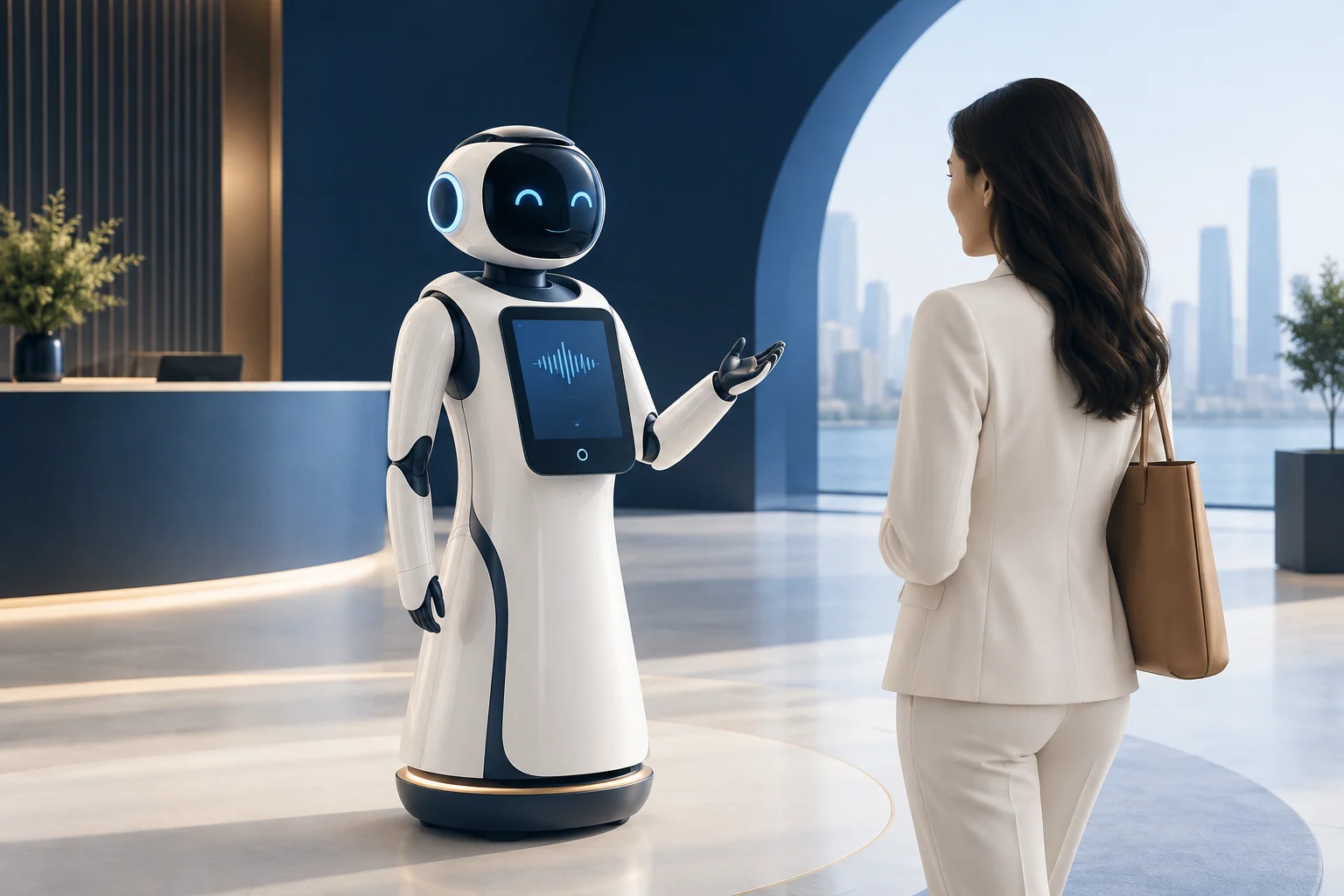
The software coordinates greeting, multilingual dialogue, knowledge retrieval, visitor check-in and approved service handoffs through one front-desk interaction workflow.
- Approach and greeting: A visitor approaches a compatible device. The software detects the interaction and greets the visitor in a configured language.
- Intent capture: The visitor speaks a request. The software performs real-time speech recognition and intent understanding to classify the request.
- Knowledge retrieval: The software queries approved customer-service knowledge and question-answering logic to formulate a response.
- Visitor registration: If the request involves check-in or onboarding, the software guides the visitor through information collection steps.
- Attention cues:Where approved camera integrations are configured, visual attention cues support more responsive interaction.
- Integration and handoff:The software routes relevant session details to connected business systems or authorized staff for follow-up.
- Session closure: The session is closed, and relevant data is handled according to configured operational workflows.