
The challenge
Retail and digital commerce organizations typically manage store discovery, local marketing, loyalty and community engagement in separate systems. Each system carries its own data model, its own interface and its own notion of what nearby means. The result is a fragmented experience for the shopper and a fragmented operating picture for the merchant.
At the same time, physical proximity remains one of the strongest signals of commercial intent. A person standing outside a store is closer to a purchase decision than a person browsing a remote catalogue. Most digital tools, however, treat location as an attribute — a postcode, a filter, a map pin — rather than as the organizing layer of the experience.
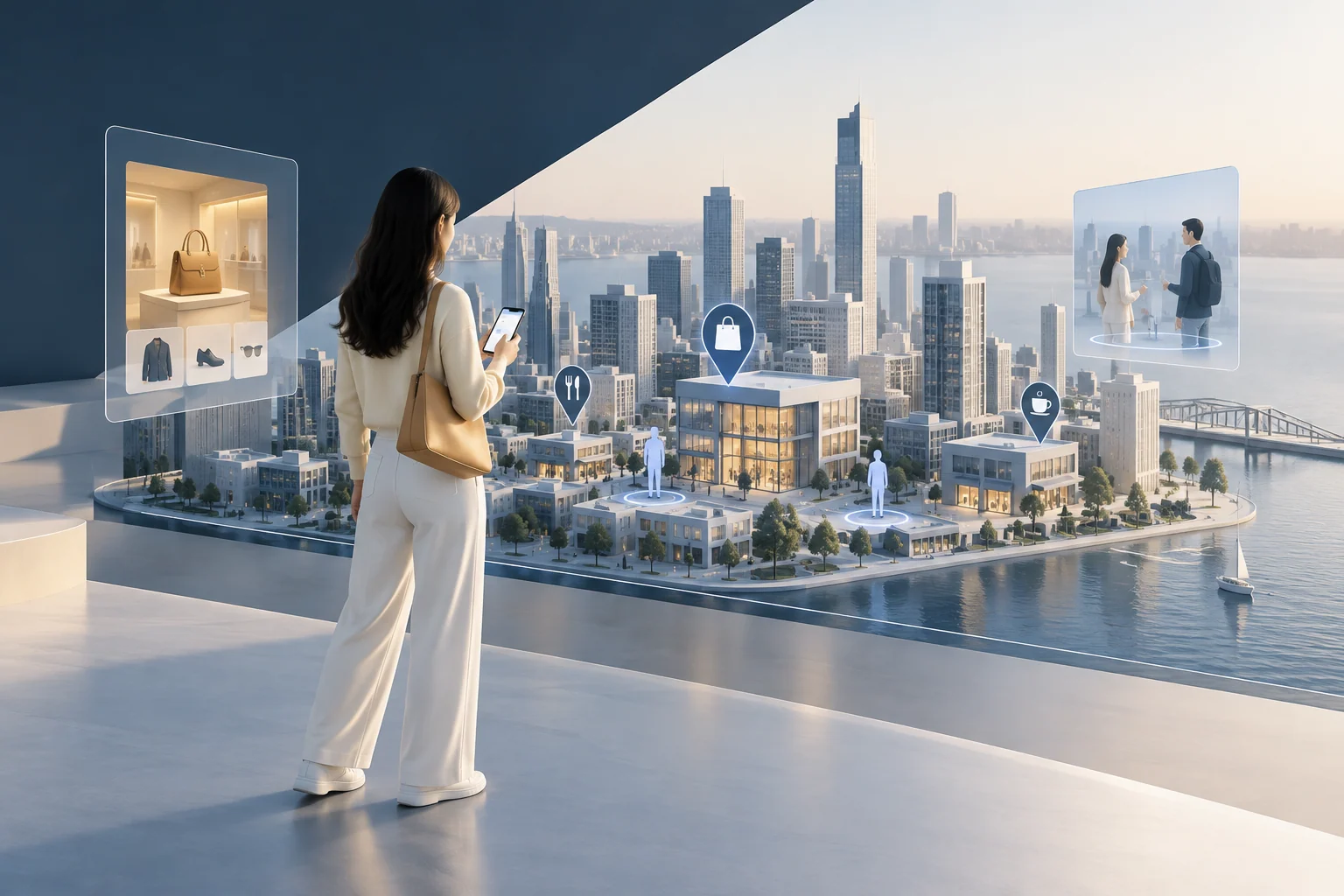
Artery addresses that gap by treating place as the primary context. Discovery, commerce and social participation all take place on the same spatial canvas, so a user's position in the world determines what they can see, whom they can meet and which merchants they can explore.
Core capabilities
Location-based 3D map and personalized avatars
A navigable 3D representation of real places forms the base layer of the platform. Users are represented by personalized avatars, which carry identity and presence into the shared space rather than reducing a person to a map pin or a list entry.
Multi-user spatial presence and user-to-user communication
Signed-in users can see other participants within the shared 3D map and communicate with them. Presence is spatial: who is visible depends on where the user is, which makes the map a social environment rather than a static directory.
Map-based store discovery, merchant experiences and shopping journeys
Local merchants are represented as destinations on the map. Discovery, evaluation and the shopping journey begin from the same spatial view, so a user can move from noticing a store to exploring what it offers without switching context.
Proximity-aware branded AR storefronts and virtual store exploration
When a user is physically near a participating store, the camera can reveal a branded AR storefront. From there, the user can explore an interactive virtual interior. The proximity condition is what distinguishes this from a general AR filter: the experience is anchored to a real location and a real merchant.
Location-anchored social posts with user interactions
Users can create geolocated social posts. Other users discover those posts at the same place and can interact with them.
Camera-based floating AR social content linked to physical locations
The same posts can be experienced as floating AR content through the camera, tying user-generated content to a specific physical location rather than to a chronological feed.
How it works
- Sign in and enter the map. A user signs in and appears on the shared 3D map as a personalized avatar.
- See who is present. Other participants are visible in the same spatial context, and the user can communicate with them.
- Discover merchants. Local merchants appear as destinations on the map, giving the user a spatial view of what is nearby.
- Approach a participating store. Physical proximity to a participating store unlocks the augmented-reality layer.
- Open the camera. A branded AR storefront appears, and the user can explore the store's interactive virtual interior.
- Contribute and discover social content. The user can leave a geolocated post, and can find posts left by others at the same place, either in the map context or as floating AR content through the camera.
Business value
By bringing digital place discovery, merchant experiences and community interaction into one spatial environment, Artery creates a connected journey across physical locations and digital services.